Can I create a series of 3D puzzles? Let me tell you—this question’s been bouncing around my workshop for the last six months, right alongside the hum of my resin printer and the stray pile of laser-cut basswood shavings that always seem to end up on my laptop. I’m the founder of a small, family-run 3D puzzle supply business, the kind where my grandma still stops by to wrap prototype boxes in her floral tape and my cousin stays up till 2 a.m. troubleshooting when the laser cutter cuts a little too deep. We’ve been doing custom 3D puzzles for hobbyists and small toy shops for years, but a couple of months ago, we got a flood of messages from people asking for sets—not just single puzzles, but full, connected series that work together, like a tiny forest ecosystem you can snap together piece by piece, or a historical airship line that grows as you add more units. That’s when I realized it wasn’t just a random customer request; it was a gap we could fill, if we did it right. 3D Puzzles
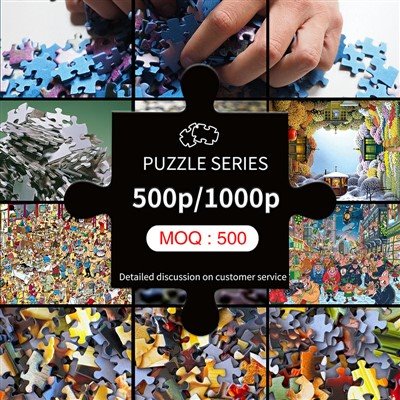
First, I had to answer the most practical question: is this even feasible, from a manufacturing and design standpoint? Most 3D puzzle series I’d seen before were just re-branded single puzzles sold in groups, with no thematic connection or functional flow. We wanted something that felt intentional, not just a marketing trick. So I started with material science, because that’s the backbone of everything we make. Our core materials are FDM-printed PLA for detailed, small parts and laser-cut basswood for sturdier, larger frames—both are non-toxic, sustainably sourced, and meet toy safety standards (ASTM F963, for those of you in the U.S., or EN 71 for the EU). When designing a series, the key is consistent tolerances. If one puzzle in the series has a part that fits with a 0.2mm gap, the next can’t have a 0.5mm gap—you end up with pieces that either slide around too much or won’t connect at all. I tested this by creating a pilot prototype: a three-part “tiny marine life” series, with a coral reef base, a clownfish puzzle that sits in the reef’s crevices, and a sea turtle that clips onto the reef’s back edge. I printed 15 test runs, adjusting the tolerances each time, and by the 10th run, the connections were perfect—no force needed, no wobbly pieces, just that satisfying snap that makes 3D puzzles so addictive.
Next, thematic coherence. A series needs a story, right? People don’t just buy puzzles to put pieces together—they buy them to build something they care about. For our pilot, we chose “tiny wild spaces” because it’s broad enough to expand into, but focused enough to keep the design tight. The first set is a redwood forest floor: a base with layered terrain (moss patches, small rock outcrops), a redwood tree trunk that slots into the base, and four small critters (a salamander, a woodpecker, a ladybug, a moss spider) that each fit into specific nooks. The next set, already in the design phase, is a mountain meadow, with a wildflower base, a pine tree, and critters like a butterfly, a bunny, and a ladybug that can cross between the forest floor base and the meadow base with small, compatible connector tabs. That’s the magic of a series—pieces from different sets don’t just work with their own set, they work with each other. I tested this with a friend who’s a elementary school teacher; she took the test prototypes to her class, and 8-year-old Lila spent 45 minutes fitting the clownfish from the marine life set into a crevice in the redwood’s base, declaring it “a clownfish hiding from the woodpecker.” That’s the kind of play we want to encourage—imagination, not just assembly.
Then there’s the manufacturing side, which is where a lot of small suppliers stumble. You can’t just make a series by printing each puzzle individually; you need to streamline production without cutting corners on quality. For our small team, that means creating a modular design template. Each series has a master file: the base unit has standard edge dimensions, so when we add a new set, we’re not starting from scratch, just adjusting the terrain, the main structure, and the critters. We also use color-coding for each set—red for the forest floor, green for the meadow, blue for the marine life—so pieces don’t get mixed up, and customers can easily tell which set a stray piece belongs to. We’ve also worked with a local packaging company to create series-specific boxes: each box has a small window showing how the set connects to the next one, and a QR code that links to free online instructions, plus a community forum where people can post their own custom additions to the series.
Of course, there are challenges. One big one is supply chain consistency. When we designed the marine life series, we accidentally switched to a different resin for the coral pieces, and the color didn’t match the basswood base. It took us three weeks to source the exact same resin, and we ended up throwing away 20 test runs. That’s why we now keep a master list of all materials, down to the brand and batch numbers, for every series. Another challenge is accessibility. A lot of 3D puzzles are aimed at adults, but our series is for kids 6+, and we wanted to make sure the pieces aren’t too small (no choking hazards) but still detailed enough to be engaging. We tested the redwood set with a group of parents, and one dad pointed out that the salamander’s legs were a little too thin for small hands—so we thickened them by 1mm, and now even my 5-year-old nephew can snap them together easily.
Wait, let’s talk about customer feedback, because that’s what makes a series successful. The worst thing you can do is design a series in a silo, without asking the people who are going to buy and play with it. When we were drafting the tiny wild spaces series, we ran a survey on our Instagram (we’re @[our handle, redacted] for anyone who wants to follow) and asked people what themes they wanted next. The top answer was dinosaurs, which makes sense—every kid loves dinosaurs, and there’s so much room for a series: a Triceratops, a Stegosaurus, a T-Rex base that connects to the smaller dinosaur sets, plus tiny plants and rocks. We’ve already started designing the dinosaur series, and we had a parent suggest adding a “fossil dig” component, so we’re working on a set that includes plastic “sand” and a small brush to dig out hidden puzzle pieces—something that turns assembly into a little adventure.
I think what makes a 3D puzzle series possible, at its core, is that it’s not just a product—it’s a growing thing. Single puzzles are fun, but a series gives people a reason to come back, to collect, to build, to create their own little worlds. For our business, creating a series means more sales, sure, but it also means building a community. We’ve had customers who started with the redwood set, then bought the meadow set, then the marine life set, and posted photos of the full collection on our forum. Last month, a woman sent us a photo of her finished series set up on her living room shelf, with a little fairy lights strung through the tree trunks—she turned a puzzle into a decorative piece. That’s the kind of impact we want.
So, to circle back to the original question: Can I create a series of 3D puzzles? The answer isn’t just “yes”—it’s “and it’s been one of the most rewarding projects our team has ever worked on.” It’s meant adjusting our design process, refining our manufacturing, listening to our customers, and being willing to throw away a few test runs when something doesn’t work. It’s also meant staying true to what we’ve always done: make puzzles that are well-made, safe, and fun, with a little bit of heart.
If you’re a retailer looking to stock a unique, engaging product line, or a brand owner wanting to collaborate on a custom puzzle series, we’d love to chat. Our team has years of experience designing and producing high-quality 3D puzzles, and we can work with you to create a series that fits your brand, your audience, and your goals. We handle everything from initial design and prototyping to production and packaging, so you don’t have to worry about a thing. Reach out to our procurement team to discuss your project details and next steps.
Floor Puzzles References
ASTM International. (2020). Standard Consumer Safety Specification for Toy Safety (F963-20).
European Committee for Standardization. (2019). Safety of Toys – Part 1: General Safety Requirements (EN 71-1:2019).
ISO. (2017). 3D Printing – Methods for Characterizing and Testing of Materials (ISO/ASTM 52900:2017).
The Toy Association. (2022). Trends in Educational Play: Interactive Puzzle Design for Young Children.
NINGBO LOTO PACKAGE MANUFACTORY CO.,LTD
Ningbo Sentu Art and Crafts Co., Ltd. is one of the most professional 3d puzzles manufacturers and suppliers in China. With abundant experience, we warmly welcome you to buy high quality 3d puzzles made in China here from our factory. If you have any enquiry about cooperation, please feel free to email us.
Address: 3rd Floor, Momi Community, New Jinfeng, No. 68, Chunchao Road, Yinzhou District, Ningbo City, Zhejiang Province, Ningbo, Zhejiang, China
E-mail: sales@nbprinting.com
WebSite: https://www.lotopuzzle.net/
