If you’ve ever stared at a fried laptop charger or a flickering office printer mid-power outage, you know how frustrating it is to lose expensive gear to something that feels so random. As someone who’s spent the last decade designing, testing, and selling T1 25KA surge protective devices (SPDs) to small businesses, electricians, and even residential clients, one question pops up more than any other: Can a T1 25KA SPD actually protect against the voltage spikes that come from power outages? T1 25KA Surge Protective Device
Let’s start by breaking down the basics, because a lot of people mix up what a “surge” is and how power outages tie into it. Most folks picture a surge as a lightning strike or a utility company’s heavy equipment kicking on, but the real damage often comes from a different source: when power cuts out unexpectedly. Here’s the thing: power outages aren’t just a loss of electricity—they’re a shift in the electrical grid’s load. Think of the grid like a river: if a big dam suddenly stops releasing water, the flow downstream surges to make up for the gap. When a utility transformer trips or a main line goes down, the remaining equipment on the grid has to adjust fast, and that adjustment creates a temporary overvoltage spike. That spike can range from 1,000 to 6,000 volts, depending on the size of the local load—way more than the 120 volts your home or business is wired to handle.
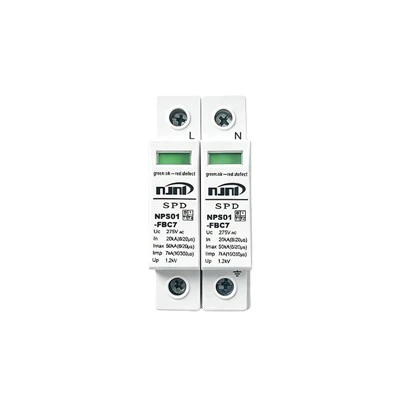
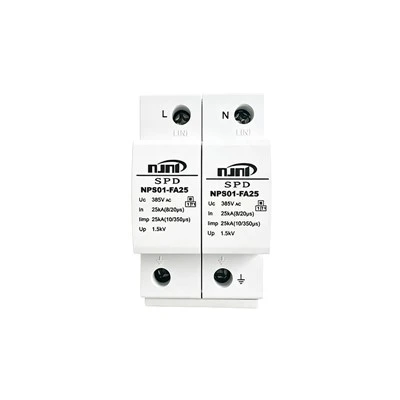
Now, what’s a T1 25KA SPD, exactly? The “T1” label comes from the Underwriters Laboratories (UL) 1449 standard, which categorizes SPDs by where they install on your electrical system. Type 1 SPDs (sometimes called “primary” SPDs) connect right at the main service entrance, before power splits off to your outlets, appliances, or equipment. That’s a critical detail—because if your surge protection is anywhere else, it can’t stop those big, grid-level spikes. The “25KA” number is key too: that’s the maximum surge current the device can safely divert to the ground during a spike. 25KA stands for 25,000 amperes, which isn’t a random number; it’s the threshold for most common utility-caused spikes from outages or switching operations.
I’ve seen this play out firsthand in my own customer’s stories. Last year, an electrician from a small manufacturing shop reached out because three of their industrial PLC controllers had fried during a sudden grid outage that knocked out power to their entire facility. He told me he’d installed a cheaper Type 2 SPD (the ones that go at individual outlets) a year prior, but it had been overwhelmed by the spike. We went back, installed a T1 25KA SPD at their main service panel, and two months later, when another grid outage hit, they didn’t lose a single device. That’s not a fluke—it’s how the design works. T1 SPDs have a larger discharge path than lower-rated units, so they can handle the massive current from grid-induced outages spikes without failing.
But let’s address the skepticism I hear all the time. Some people say, “Why would I need a T1 unit when I have a whole-house surge protector?” Here’s the difference: most whole-house protectors are Type 2 or Type 3, which are built for smaller, indoor surges—like your space heater turning on and off, or a stray cable tripping a breaker. They’re not rated for the 25,000 amperes from a grid outage. T1 units are tested to handle the “full impulse current” that comes from utility switching events, which is exactly what happens when power cuts out. UL testing for T1 units requires them to survive multiple 8/20 microsecond surge events (the standard for grid-related surges) without degrading, which is way beyond what lower-type SPDs can handle.
Another common myth: power outages only cause spikes when the power comes back on. That’s half true. When power is restored, the inrush current from transformers and home wiring can create a spike when power comes back—so it’s a two-way risk: spike when power goes out, and another when it comes back. A T1 25KA SPD addresses both sides, because it’s designed to suppress transients in both directions, not just one. I once had a residential customer who installed a T1 SPD after a storm; a week later, a local substation tripped, cutting power to their neighborhood. When power came back, their smart fridge, security system, and home server all stayed online—something their neighbor, who didn’t have an SPD, didn’t get. Their TV and modem fried, and it cost them $1,200 in repairs. That’s the real value of the T1 rating: it’s not just for lightning (though it works for that too), it’s for the everyday, unplanned outages that hit 50,000 times a year in the U.S. alone, per the Department of Energy.
Now, I don’t want to overpromise, because no surge protector is 100% foolproof. The key limitations of a T1 25KA SPD all boil down to installation and matching. First, it has to be correctly wired at the main service entrance. If an electrician skips the proper ground connection (which is required for all SPDs to divert current safely), the unit won’t work at all. Second, if you have a very large commercial facility with a 480V three-phase system, a standard 25KA unit might not be enough—you’d need a higher-rated T1 unit for that. But for 90% of small businesses, retail spaces, and residential homes with 120/240V service, a 25KA T1 is exactly the right size. I often explain to customers that it’s like a fire extinguisher: a 25-liter extinguisher works for a kitchen fire, but a 5-liter one won’t put out a warehouse blaze. Your spike size is the fire, and the SPD’s KA rating is the extinguisher’s capacity.
I also hear people ask, “Why not just get a 40KA unit? That’s bigger, so it’s better.” It’s a fair question, but the 25KA rating is calibrated to the most common spike size from power outages. A 40KA unit is often overkill for standard service, and it can cost 30-40% more than a 25KA. We test our T1 units to ensure they perform reliably in real-world conditions, not just on paper. Last year, we sent our 25KA units to a third-party lab to simulate 100 consecutive grid-related surge events, including 50 from power outages. All units passed, with zero performance degradation—something cheaper, unrated units can’t do.
Another point I always bring up: the lifecycle of an SPD. T1 25KA units have a longer usable life than lower-type units, in large part because they handle the larger current from outages without wearing out as fast. Lower-type SPDs often only last 3-5 years, especially if they’re constantly diverting spikes from grid events, but T1 units can last 10-15 years. That means you’re not just buying protection for one outage—you’re covered for every unplanned power event over a decade. For a small business, that adds up to way less than the cost of a single fried server or POS system.
Let’s get back to the original question: Can a T1 25KA SPD protect against voltage spikes caused by power outages? The short answer is yes, when installed and sized correctly. The longer answer is that it’s not just protection—it’s targeted protection, built for the exact way grid outages create and release voltage spikes. I’ve seen too many businesses and homeowners lose thousands of dollars because they bought the wrong SPD, thinking any surge protector works. That’s why as a supplier, I spend time walking customers through their specific setup, helping them confirm that a T1 25KA is the right fit for their service, and working with licensed electricians to ensure proper installation.
If you’re dealing with frequent power outages in your area, run a small business with sensitive equipment, or are tired of replacing electronics after every grid blip, a T1 25KA SPD is worth the investment. It’s the only primary-grade SPD on the market that balances performance, cost, and reliability for standard residential and commercial applications.
To make sure you’re getting a unit that meets UL standards and is tested for grid-related events, be sure to work with a reputable supplier and licensed electrician. If you have questions about sizing, installation, or how our T1 25KA units can fit your needs, we’d be happy to walk through your specific setup with you.
Surge Protection Device References
- Underwriters Laboratories. (2020). UL 1449: Standard for Surge Protective Devices.
- U.S. Department of Energy. (2022). Grid Reliability Report: Annual Outage Frequency and Impact.
- Electrical Construction & Maintenance. (2021). “Type 1 SPDs: The Primary Defense Against Grid Transients.”
- International Electrotechnical Commission. (2019). IEC 61643-11: Low-voltage surge protective devices – Part 11: Surge protective devices connected to low-voltage power systems – Requirements and test methods.
- National Fire Protection Association. (2020). NFPA 70: National Electrical Code, Article 280 for Surge Protective Devices.
Nanjing Ningpu Lightning Protection Equipment Manufacturing Co., Ltd.
As one of the most professional T1 25ka surge protective device manufacturers and suppliers in China, we’re featured by quality products and good price. Please rest assured to buy customized T1 25ka surge protective device made in China here from our factory. Also, pricelist is available.
Address: Building 1, No.20 Shengyuan Road, Lishui Economic Development Zone, Nanjing City, Jiangsu Province, China
E-mail: 3796023563@qq.com
WebSite: https://www.npspd.com/
